2015-05-02

Polin

Pranas knygas skaito.

Vilnius. Eugrimas. 2006" 25 puslapyje rašo:

 "Lenkija hebraiškai vadinama Polin. Pasakojama, jog perėjusi Lenkijos sieną, grupelė tremtinių žydų išgirdo balsą tariant "po lin", o tai reiškia "apsigyvenk čia"11. Pagal kitas tradicijas hebraiškas šios šalies pavadinimas kildinamas iš žodžių „po lan Ja“, kas reiškia „čia gyvena viešpats“. 


11 Perpasakodamas šią sakmę S.Y.Agonas žodžius po lin traktuoja kaip maldą: „Kodėl ji buvo pavadintaPolin? Todėl, kad žydų tauta meldėsi Švenčiausiajam, tebūnie Jis palaimintas: ′Visatos valdove, jeigu mūsų atpirkimo valanda dar neatėjo, būk čia [po lin] šią tremties naktį su mumis, kol nuvesi mus į Izraelio žemę.′“ S.Y.Agnon. „Kedumot“, su nežymiais pakeitimais cit. Iš H.Bar-Itzhak. Jewish Poland: Legend of Origin. Ethnopoetics and Legendary Chronicles. Detroit, 2001, p. 33. 
26-me puslapyje rašo: „Taigi Lenkijos žydai ir jų kaimynai krikščionys suvokė, jog žydai šalyje apsistojo visiems laikams. Legendomis pagrįsta žodžių Polin ir Polanja etimologija atskleidžia žydų supratimą, jog ši gyvenamoji vieta jiems buvo skirta Dievo.“

Taigi Lenkijos žydai ir jų kaimynai krikščionys...

O kur prapuolė pagonys?

Some Jewish historians say the Hebrew word for 'Poland' is pronounced as Polania or Polin in Hebrew. As transliterated into Hebrew, these names for Poland were interpreted as "good omens" because Polania can be broken down into three Hebrew words: po ("here"), lan ("dwells"), ya ("God"), and Polin into two words of: po ("here") lin ("[you should] dwell"). The "message" was that Poland

was meant to be a good place for the Jews. 
In later centuries up to 80% of the Jewish world population lived in Poland.

Rytų Europos žydai anksčiau būdavo vadinami tiesiog lenkais.

Tiesiog.

Kuriais lenkais? 

Kieno polka, o kieno - polonezas?

Beliko tik pastebėt, kad frankai braidžioja.
Ir kad poliakai, vienok, polinais nepanoro vadintis.

Legendomis pagrįsta žodžių Polin ir Polanja etimologija atskleidžia žydų supratimą, jog ši gyvenamoji vieta jiems buvo skirta Dievo...

Ar tikrai?

Vien klausimai...

Ir atsakymai.


Known as paradisus Iudaeorum (Latin for "Paradise for the Jews"), it became a shelter for persecuted and expelled European Jewish communities and the home to the world's largest Jewish community of the time. 


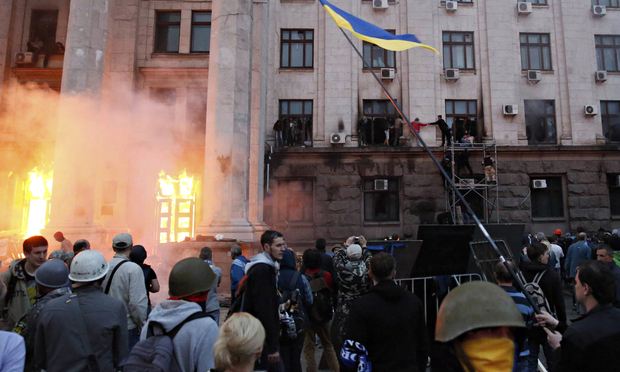
2 May 2014 in Odessa

The worst incident occurred on 2 May, when forty-three pro-Russian anti-Maidan protesters were killed during a confrontation with pro-Ukrainian unity protesters at the .


Trade Unions House in central Odessa.
1 May 2014 in Odessa.

The Old New Financial Risk

Old New.
Panašiai kaip Старонова синагога.
Nes 39 metai.

Nes be Jubiliejaus metų - niekaip.

APR 28, 2015
WASHINGTON, DC – The main financial risk facing the United States today looks very similar to what caused so much trouble in 2007-2008: big banks with too much debt and too little equity capital on their balance sheets. Uneven global regulations, not to mention regulators who fall asleep at the wheel, compound this structural vulnerability.

We already saw this movie, and it ended badly. Next time could be an even worse horror show.

All booms are different, but every major financial crisis has at its heart the same issue: major banks get into trouble and teeter on the brink of collapse. Disruption at the core of any banking system leads to tight credit, with major negative effects on the real economy. In our modern world, in which finance is interwoven throughout the economy, the consequences can be particularly severe – as we saw in 2008 and 2009.


Thomas Hoenig, vice chairman of the Federal Deposit Insurance Corporation, publishes his own calculation of capital levels at the world’s largest banks, and these data are now available through the end of 2014. The most leveraged big US bank, Morgan Stanley, has less than 4% equity, meaning that 96% of its balance sheet is some form of debt. The average for big US banks is just under 5% equity.

This is more – but not much more – capital than some troubled banks had in the run-up to the financial crisis in 2008. Citigroup, for example, had no more than 4.3% equity, according to Hoenig’s calculation, in November 2008. At the end of 2012, when Hoenig started to publish his US GAAP-IFRS adjustment, the average for the largest US banks was roughly 4% equity.

But the most dangerous shocks may be those that originate with the big banks themselves. The latest significant development to surface is what Better Markets, a pro-reform group that has put out a helpful fact sheet, calls “de facto guaranteed foreign subsidiaries” that trade derivatives – a murky phenomenon that likely involves all the big players. The trick here is that a de jure guaranteed foreign subsidiary of a US bank would have to comply with many US rules, including those governing conduct, transparency, and clearing (how the derivatives are actually traded). A foreign subsidiary that is supposedly independent is exempt from those rules.

But, as Dennis Kelleher of Better Markets points out, when pressure mounts and a crisis seems around the corner, banks will face great pressure to bring such subsidiaries back onto their balance sheet. This is exactly what happened in the last crisis, with Citigroup being a leading example.
The main reason why such loopholes are left open is that regulators choose not to close them. Sometimes this may be due to lack of information or awareness. But, in many cases, the regulators actually believe that there is nothing wrong with the behavior in question – either because they have been persuaded by lobbyists or because they themselves used to work in the industry (or could go work there soon.)

Sound familiar?

Simon Johnson 

Simon Johnson, a former chief economist of the IMF, is a professor at MIT Sloan, a senior fellow at the Peterson Institute for International Economics, and co-founder of a leading economics blog, The Baseline Scenario. He is the co-author, with James Kwak, of White House Burning: The Founding Fathers… read more